
Retrieval-Augmented Generation
RAG Systems That Answer From Your Data, Not Thin Air
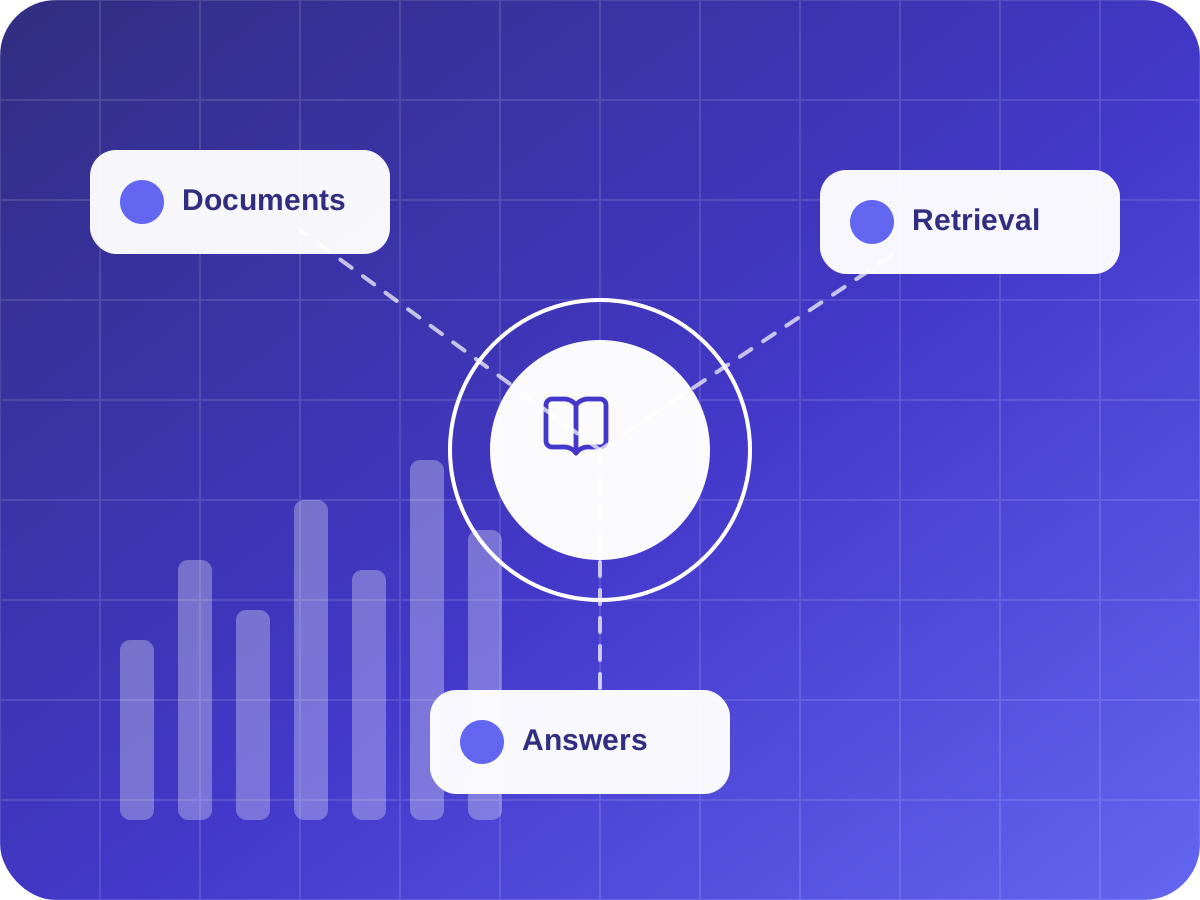
A vanilla LLM makes things up. A well-built RAG system cites sources, stays grounded, and gets smarter as your knowledge base grows. We build production RAG pipelines with the retrieval precision, evaluation rigour, and hallucination controls that enterprise applications demand.
- Citation enforcement
- Hybrid search
- Hallucination controls
Our Service Capabilities
End-to-end capability, from strategy and build to integration, monitoring, and ongoing support.
Document Ingestion & Chunking
Intelligent document parsing, chunking, and preprocessing, handling PDFs, Word, HTML, and code with layout-aware chunking strategies that preserve semantic coherence.
Embedding & Indexing
Embedding model selection and evaluation (OpenAI, Cohere, BGE, E5), with vector index optimization for your corpus size, query volume, and latency requirements.
Hybrid Search Architecture
Combining dense vector search with BM25 sparse retrieval and cross-encoder re-ranking, delivering higher recall and precision than vector search alone.
Citation & Attribution Enforcement
Grounding mechanisms that require the LLM to cite specific sources, with automatic source attribution and confidence scoring, so every answer is auditable.
RAG Evaluation Framework
Automated RAGAS evaluation pipelines with golden test sets, measuring context recall, answer faithfulness, answer relevance, and regression testing on every deployment.
Agentic RAG & Multi-hop Reasoning
Advanced RAG architectures for complex queries requiring multi-hop reasoning, iterative retrieval, query decomposition, and result aggregation across multiple knowledge sources.
Our Engagement Process
A disciplined, outcome-focused approach from first call to go-live.
01
Knowledge Audit & Source Mapping: Inventory your knowledge sources, documents, databases, APIs, and design the ingestion and update strategy.
02
Chunking & Embedding Strategy: Design and test chunking approaches, select and evaluate embedding models on your specific corpus and query patterns.
03
Retrieval Pipeline Build: Implement vector index, hybrid search, re-ranking, and context assembly, with iterative retrieval precision benchmarking.
04
LLM Integration & Grounding: Connect the retrieval pipeline to your LLM with grounding instructions, citation enforcement, and confidence scoring.
05
Evaluation & Production Launch: Build the RAGAS evaluation pipeline, run golden-set testing, deploy to production, and set up ongoing evaluation monitoring.
Tools & Frameworks We Master
A production-tested, vendor-agnostic stack built for enterprise security and compliance requirements.
Orchestration
LangChain, LlamaIndex, LangGraph, DSPy, Haystack, Ragas
Vector Databases
Pinecone, Weaviate, pgvector, Qdrant, Milvus, Redis Vector
Embedding Models
OpenAI text-embedding-3, Cohere Embed, BGE-M3, E5-large, Jina Embeddings, GTE
Evaluation
RAGAS, DeepEval, TruLens, Promptfoo, LangSmith, Helicone
What a vector database does in a RAG system
A vector database stores embeddings, which are number-based versions of text. It finds passages that are close in meaning to a question, even when the exact words differ. The RAG pipeline then gives those passages to the LLM as context for its answer.
An embedding model converts each document chunk into a vector. The same model converts each question. The database returns the chunks whose vectors sit closest to the question.
This is vector search, also called similarity search. It handles questions worded differently from the source text, which keyword matching often misses.
How we choose a vector store
The right store depends on data volume, how results are filtered, and where the data may be hosted. We compare options during the review instead of recommending one product for every project.
Corpus size and query volume
Small and mid-size collections can run on a simple index. Large collections need a store built to scale.
Filtering by user or permission
Access rules must limit which chunks a user can retrieve. We confirm the store applies filters before results reach the LLM.
Hosting and data residency
Managed and self-hosted stores differ on where data is held. Regulated data often needs self-hosting or a region the client controls.
Existing database
If the data already sits in PostgreSQL, pgvector keeps vectors next to it. It is one option among several.
Pinecone, Weaviate, pgvector, Qdrant, Milvus and Redis Vector are all in our toolkit. Each fits different constraints, so we match the store to your project.
Vector search vs keyword search
Vector search finds passages by meaning. Keyword search finds passages by exact terms. Each fails in different cases, so many RAG systems combine them through hybrid search.
| Vector search | Keyword search (BM25) | Hybrid search | |
|---|---|---|---|
| Finds passages by | Meaning and similar phrasing | Exact words and terms | Both, with results merged |
| Strong at | Questions worded differently from the source | Product codes, names and exact terms | Mixed queries that need both |
| Weak at | Rare identifiers the embedding model has not learned | Synonyms and paraphrased questions | More setup and tuning |
Our hybrid search architecture, described above, combines both methods and adds cross-encoder re-ranking to order the final results.
What is RAG and why is it better than fine-tuning?
RAG (Retrieval-Augmented Generation) retrieves relevant documents at query time and uses them to ground LLM responses. Unlike fine-tuning, RAG works with knowledge that changes frequently, provides citations, and does not require expensive retraining when your knowledge base updates.
What types of documents can RAG work with?
RAG works with PDFs, Word documents, HTML, Markdown, plain text, JSON, structured databases, and code repositories. We build preprocessing pipelines that handle mixed document types, scanned PDFs (with OCR), and multi-language content.
How do you measure RAG system quality?
We evaluate RAG systems on retrieval metrics (recall@k, MRR, NDCG). We also measure generation metrics (answer faithfulness, context relevance, and answer relevance using RAGAS). Business metrics include user satisfaction and resolution rate. We build automated evaluation pipelines with golden test sets.
How do you prevent hallucinations in RAG systems?
We implement multiple layers. They include strict context grounding (the LLM is instructed to answer only from retrieved context), citation enforcement, and confidence scoring. They also include faithfulness evaluation using RAGAS and human-in-the-loop review for low-confidence responses.
Can RAG work with structured data like databases?
Yes. We build hybrid RAG systems that combine vector search over unstructured documents with SQL query generation (text-to-SQL) over structured databases. The agent can then answer questions that require both document retrieval and data analysis.
How long does it take to build a production RAG system?
Timing depends on the size of the document set, the number of sources and the evaluation depth. We agree the scope and plan after the first review.
Do we need a vector database for every RAG project?
Not always. Small document sets can work with a simpler index. We choose the store by corpus size, filtering needs and where the data must be hosted.
Can an existing PostgreSQL database store vectors?
Yes, with pgvector. It fits many projects because the vectors sit next to your existing data. Larger or filter-heavy workloads may need a dedicated store, which we compare during the review.
Ready to build your RAG system?
Tell us about your knowledge base. We will design a production-grade RAG pipeline with the retrieval precision, citation enforcement, and evaluation rigour your application demands.