
Predictive Analytics AI
Predictive Analytics That Drives Real Decisions
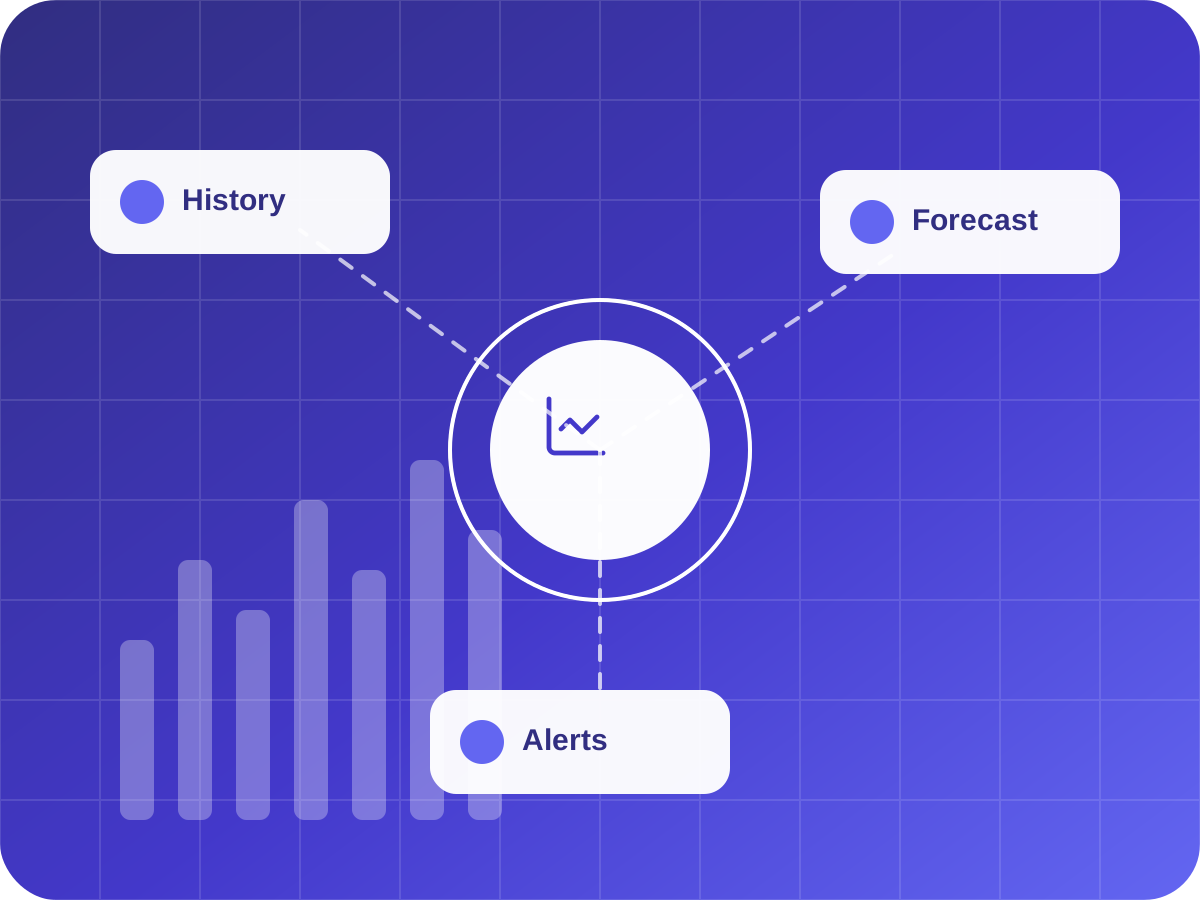
Stop reacting to what already happened. Predictive analytics tells you what will happen next, and gives your team the lead time to act. We build production prediction systems that surface the right insights at the right time - embedded in the tools your teams already use.
- Demand forecasting
- Churn & risk scoring
- Anomaly detection
Our Service Capabilities
End-to-end capability, from strategy and build to integration, monitoring, and ongoing support.
Demand & Revenue Forecasting
LSTM, Prophet, and XGBoost-based forecasting models for product demand, revenue, and inventory, with configurable granularity from SKU-level to regional aggregates.
Customer Churn Prediction
Survival analysis and classification models that identify at-risk customers weeks before churn, with feature importance explanations and CRM integration for immediate retention actions.
Credit Risk & Default Scoring
Regulatory-compliant credit scoring models with explainable predictions, adverse action reasons, and bias testing, for banks, NBFCs, and lending platforms.
Anomaly & Fraud Detection
Real-time anomaly detection for financial fraud, network intrusion, equipment failure, and quality control, with configurable thresholds and human-in-the-loop review workflows.
Predictive Maintenance
Time-series models on IoT sensor data that flag equipment failure before it happens, in manufacturing and utilities.
Lead Scoring & Win Probability
ML models score inbound leads, predict deal win probability, and surface the best next action. They integrate with Salesforce, HubSpot, and your CRM of choice.
Our Engagement Process
A disciplined, outcome-focused approach from first call to go-live.
01
Define the Prediction Target: Clearly specify what you want to predict, the decision it enables, and the business value of accuracy improvement.
02
Data Audit & Feature Engineering: Evaluate data quality, identify predictive features, handle missing values, and build the feature engineering pipeline.
03
Model Development & Benchmarking: Train and evaluate multiple model families, establish baselines, and select the best-performing approach for your accuracy and latency requirements.
04
Explainability & Validation: Validate model fairness and compliance, implement SHAP explainability, and present findings to business stakeholders before deployment.
05
Production Integration & Monitoring: Deploy prediction API, integrate with dashboards or CRM, and set up monitoring for accuracy degradation and data drift.
Tools & Frameworks We Master
A production-tested, vendor-agnostic stack built for enterprise security and compliance requirements.
Forecasting Models
Prophet, LSTM, XGBoost, LightGBM, N-BEATS, TFT (Temporal Fusion Transformer)
ML Frameworks
scikit-learn, PyTorch, Statsmodels, Shap, Optuna, H2O AutoML
Data & Features
Apache Airflow, dbt, Feast, Pandas, Spark, Great Expectations
Deployment & BI
FastAPI, MLflow, Apache Superset, Tableau, Power BI, Grafana
What is predictive analytics?
Predictive analytics uses historical data, statistical algorithms, and machine learning to forecast future outcomes, customer churn, product demand, equipment failure, credit default, and more. It transforms reactive decision-making into proactive, data-driven action.
What data do we need for predictive analytics?
For time-series forecasting, you need timestamped records. For classification (churn, fraud, default), you need labelled examples. We assess data quality in discovery.
How accurate are predictive models?
Accuracy depends on data quality, feature richness, and inherent predictability of the target. We always establish baseline benchmarks and target business-relevant accuracy thresholds.
Can predictive models be integrated into our existing dashboards?
Yes. We integrate prediction outputs into Apache Superset, Tableau, Power BI, Salesforce, and custom dashboards. Your team sees predictions where they already make decisions, not in a separate tool.
How often do predictive models need to be updated?
It depends on how quickly your underlying patterns change. High-velocity domains (fraud, financial markets) may need daily or weekly retraining. Slower-changing domains (demand, churn) typically retrain monthly or quarterly. We build automated retraining pipelines so this happens without manual intervention.
What is the difference between predictive analytics and BI?
BI (Business Intelligence) tells you what happened, it reports on historical data. Predictive analytics tells you what will happen, it uses patterns in historical data to forecast future outcomes. Both are complementary: BI provides the historical context, predictive analytics provides forward-looking signals.
Ready to Add Predictive Power to Your Business?
Tell us what you want to predict, demand, churn, fraud, or risk. We will build a production prediction system with measurable business impact.