
Deep Learning Development
Neural networks trained on your hardest problems.
We design and train deep learning systems, CNNs, Transformers, and custom architectures, for vision, language, and time-series at GPU scale. Accuracy measured against your own data.
- Computer Vision
- Transformers
- Explainable
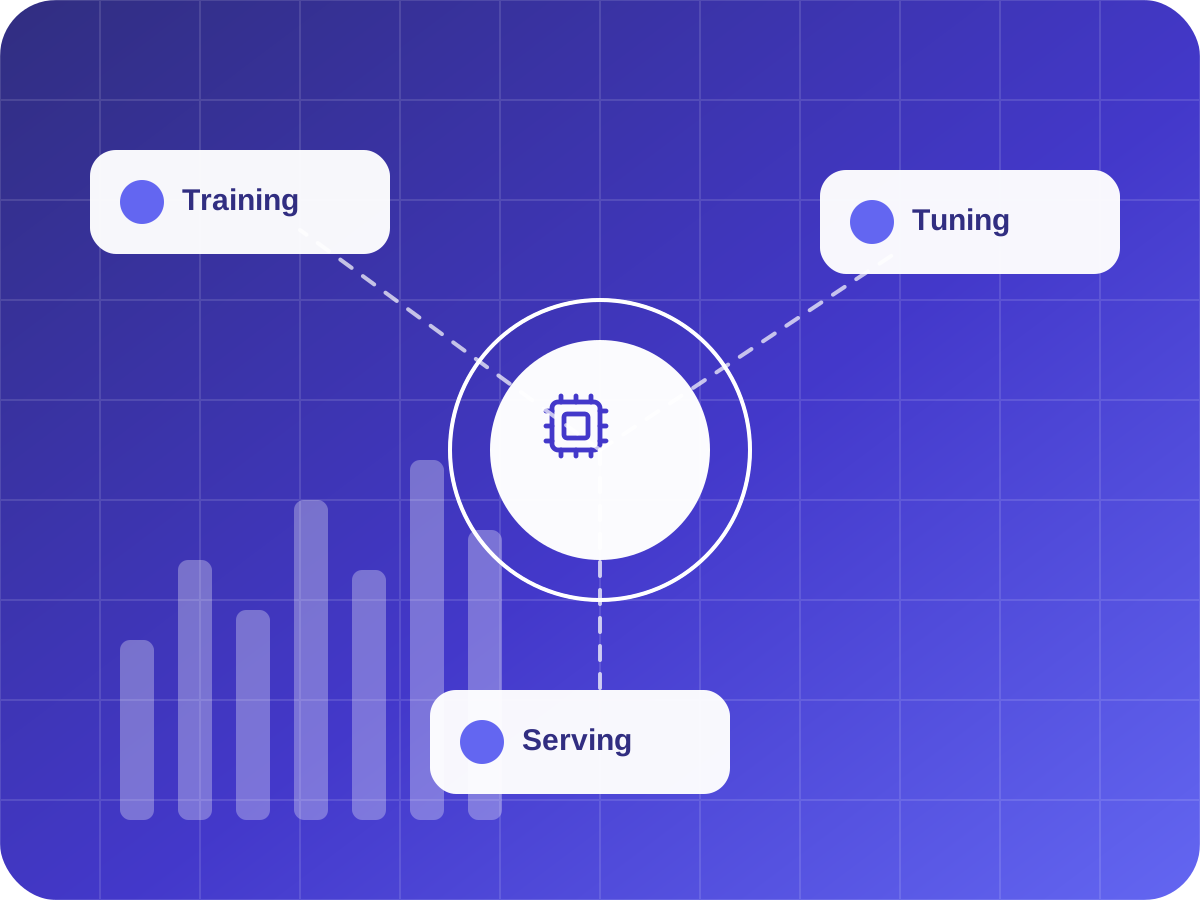
Deep Learning for Complex Data
Custom neural architectures for images, text, audio, and sequences, trained on your data.
Computer Vision
CNN-based classification, detection, and segmentation for inspection, medical imaging, and more.
Transformer Models
State-of-the-art NLP and sequence models fine-tuned on your domain language and tasks.
Time-Series Forecasting
LSTM and temporal models for demand, anomaly detection, and predictive maintenance.
Generative Models
GANs and diffusion models for image synthesis, augmentation, and design generation.
Custom Architectures
Bespoke neural networks designed and trained for your unique multimodal problem.
Model Explainability
Grad-CAM, SHAP, and attention visualisation so experts can validate every prediction.
From dataset to trained model in 5 steps
A rigorous deep learning methodology that turns large datasets into accurate, deployable models.
01
Problem & Data Audit: Assess data volume, quality, and labelling needs for the deep learning task.
02
Data Pipeline: Build augmentation and pre-processing pipelines for strong training.
03
Architecture & Train: Design the network and train at GPU scale with experiment tracking.
04
Evaluate & Explain: Benchmark accuracy and add explainability for domain validation.
05
Optimize & Deploy: Quantise and optimize for CPU, GPU, or edge, then ship to production.
Modern Deep Learning Stack
Battle-tested frameworks and GPU infrastructure for training and serving neural networks.
Frameworks
PyTorch, TensorFlow, Keras, JAX, Lightning
Vision & NLP
CNNs, ViT, YOLO, Transformers, Diffusers
Training & GPU
NVIDIA A100, H100, CUDA, W&B, Ray
Serving
TorchServe, Triton, ONNX, TensorRT, Docker
What is deep learning and when should I use it?
Deep learning uses multi-layered neural networks to learn complex patterns from large datasets. It is the right choice for unstructured data like images, text, and audio, and tasks requiring human-level perception.
How much data is needed for deep learning?
Computer vision tasks typically require 1,000, 100,000+ labelled images. NLP tasks can leverage pre-trained transformers with as few as 500, 5,000 labelled examples via fine-tuning. We assess your data during discovery.
What hardware is required?
Training requires GPU infrastructure (NVIDIA A100, H100, or V100), provided via AWS, GCP, or Azure. For inference, models can be optimized for CPUs, GPUs, or edge devices depending on latency requirements.
Can deep learning models be explained?
Yes. We implement explainability tools. These include Grad-CAM for vision models, SHAP for feature importance, and attention visualisation for transformers. Predictions can be validated by domain experts.
Can models run on edge devices?
Yes. We quantise and optimize models with ONNX and TensorRT to run efficiently on mobile and edge hardware where needed.
Ready to train your deep learning model?
Book a free consultation and we will scope your highest-impact deep learning build, no jargon, no obligation.