
Technology Comparison
ChatGPT vs Custom AI: The Honest Enterprise Comparison
ChatGPT is impressive. But 'should we just use ChatGPT?' is a question every enterprise AI decision maker faces. The answer is more nuanced than the hype suggests. Here is an honest, technical comparison of ChatGPT (and the OpenAI API) vs custom AI development - including when each approach wins.
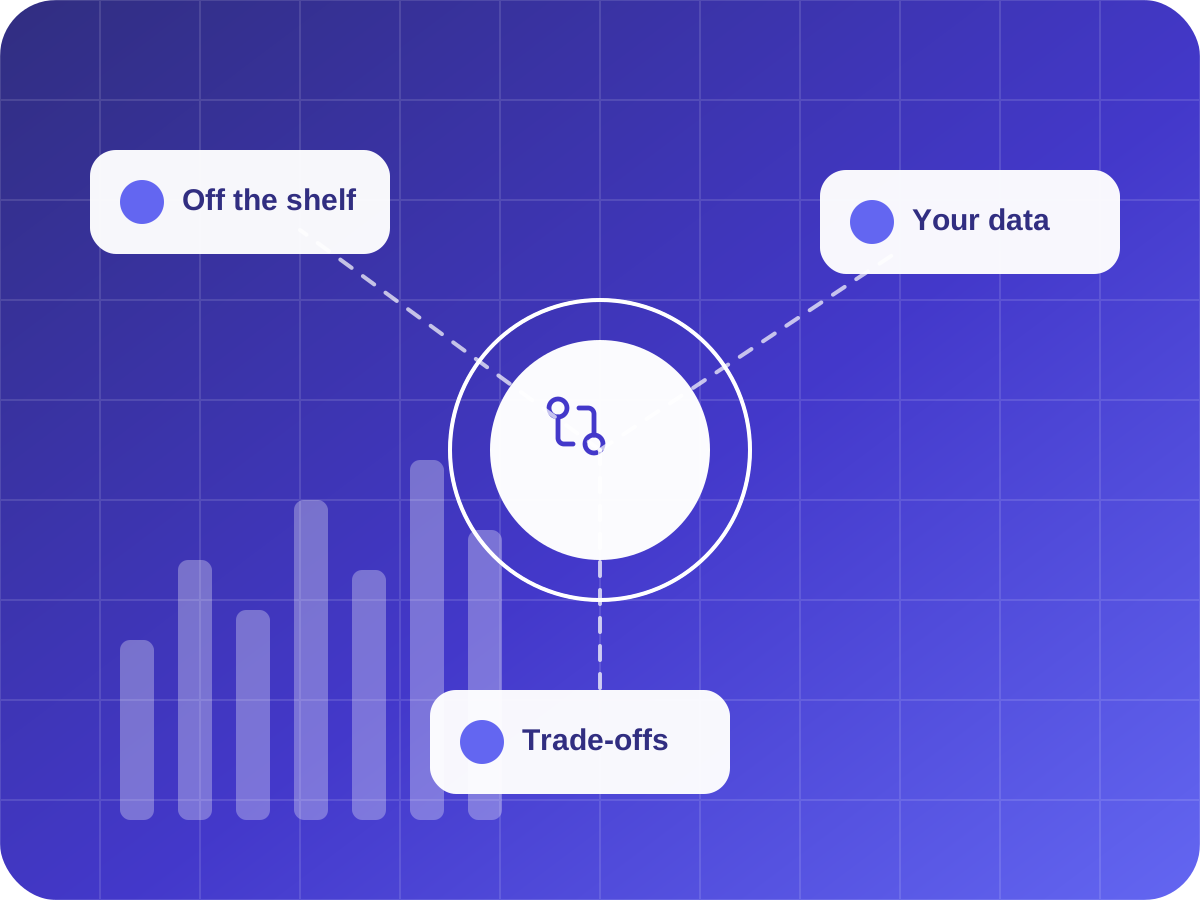
- Accuracy on domain tasks
- Data privacy & compliance
- Total cost at scale
We Help You Make the Right Choice
End-to-end capability, from strategy and build to integration, monitoring, and ongoing support.
Use Case Assessment
We analyze your specific use case, data environment, and requirements. We then give you an honest recommendation on whether ChatGPT, custom AI, or a hybrid approach is right.
PoC Benchmarking
We run head-to-head benchmarks of ChatGPT vs a custom or fine-tuned model on your actual data. Your decision is based on evidence, not vendor marketing.
TCO Analysis
We model the 3-year total cost of the OpenAI API vs a custom or self-hosted solution at your projected usage volumes. The model includes infrastructure, maintenance, and scale-up costs.
Custom AI Development
If custom AI is the right answer, we build it. That can be fine-tuned LLMs, RAG pipelines, or purpose-built ML models, with full code ownership and no vendor lock-in.
OpenAI Integration & Optimization
If ChatGPT is the right answer for now, we build a production-grade OpenAI integration. It includes semantic caching, model routing, cost controls, and a clear migration path if needed.
Hybrid Architecture
Most enterprise systems benefit from a hybrid, OpenAI for general tasks, custom models for high-stakes domain-specific decisions. We design the right split for your use case.
Our Engagement Process
A disciplined, outcome-focused approach from first call to go-live.
01
Use Case Scoping: Define precisely what the AI system needs to do, the data it requires, and the business outcome it must deliver.
02
Requirements Analysis: Document functional and non-functional requirements, accuracy, latency, compliance, integration, and scale, that any solution must meet.
03
TCO Modelling: Build a 3-year total cost model comparing build vs buy, including all hidden costs (implementation, customization, scale-up, migration risk).
04
Recommendation & Architecture: Provide a concrete recommendation with rationale, and if building, a proposed architecture and delivery plan.
05
Execution: Deliver the chosen solution, whether custom build, SaaS integration, or hybrid, with clear milestones and measurable success criteria.
Tools & Frameworks We Master
A production-tested, vendor-agnostic stack built for enterprise security and compliance requirements.
If You Build (Custom AI)
PyTorch, LangChain, MLflow, Kubernetes, Pinecone, FastAPI
Common SaaS AI Vendors
OpenAI API, Google Vertex AI, AWS AI Services, Azure AI, Cohere, Hugging Face
Evaluation Framework
TCO Modelling, Vendor Scorecard, Security Review, PoC Benchmarking, Integration Audit
Foundation Models
GPT-4o, Llama 3, Mistral, Claude 3.5, Gemini Pro
Is ChatGPT accurate enough for enterprise use?
ChatGPT (GPT-4o) handles many general tasks well. For domain-specific work, accuracy depends on your data and on how the model is tuned and evaluated.
Is ChatGPT safe to use with proprietary enterprise data?
OpenAI Enterprise API does not use your data for training. However, your data still transits OpenAI's infrastructure, which may not meet requirements for regulated industries (healthcare, finance, defence). For data sovereignty, self-hosted open-source models (Llama, Mistral) offer full control, no data leaves your environment.
How much does ChatGPT cost at enterprise scale?
OpenAI API costs $15, 60 per million tokens for GPT-4o depending on input/output. At enterprise scale (100M+ tokens/month), this quickly reaches $150K to $600K per year. That is often more than the cost of building and self-hosting a custom model that performs better on your specific tasks.
Can you build on ChatGPT and then switch to custom AI later?
Yes, and it is a common pattern. Use the OpenAI API to validate the use case quickly. Then replace it with a fine-tuned open-source model once you have proven value and accumulated training data. We often help clients architect with this transition in mind from day one.
What is the difference between using ChatGPT and building a custom LLM?
ChatGPT is a general-purpose product. Custom AI can mean three things. It can mean (a) using the OpenAI API with RAG and prompt engineering. It can also mean (b) fine-tuning Llama or Mistral on your domain data. Or it can mean (c) building a fully custom ML pipeline. The right approach depends on your accuracy requirements, data privacy needs, and cost tolerance.
When does it make sense to use ChatGPT as the foundation for a product?
ChatGPT (OpenAI API) is a strong foundation when: you need fast time to market. Your use case does not require proprietary domain accuracy. Your data privacy requirements allow cloud processing. Your usage volume does not make per-token costs prohibitive. We can help you assess whether these conditions hold for your use case.
Want a ChatGPT vs Custom AI Assessment for Your Use Case?
Tell us your use case, data, and scale. We will run a benchmark and give you a clear, evidence-based recommendation.