
Service
One Operational Picture for a Mine
How KP Iron Pvt. Ltd. moved four sites off three vendor portals and weekly spreadsheets onto MineSense IoT by Andolasoft. The result is one live view for safety, compliance and uptime.
01
The client
KP Iron Pvt. Ltd. is an Indian iron-ore producer running a multi-pit mine, an on-site beneficiation circuit and a tailings storage facility. Like most producers in the eastern iron-ore belt, it works under tightening DGMS and CPCB scrutiny. It also faces growing investor demand for ESG transparency. Its throughput targets leave no room for unplanned downtime on fixed plant.
Pit-to-port operation with on-site beneficiation, run-of-mine stockpiles and one tailings storage facility.
Open pit, underground exploratory levels, beneficiation plant and TSF, previously on three vendor portals.
02
From three portals and weekly spreadsheets to one live picture
Plenty of sensors were already in the ground. The problem was that their data never reached a decision-maker in time, or in one place.
- Three sensor vendors, three portals, three definitions of “online”
- Underground gas readings depended on manual rounds, leaving hours between readings
- Conveyor and crusher failures surfaced only at hard-threshold alarms, too late to avoid a stoppage
- Tailings data sat in a separate portal and was reviewed weekly in spreadsheets
- DGMS and CPCB inspections took days of paperwork rebuilt across maintenance, HSE and environment teams
- New “smart” sensors stalled because each spoke a different protocol with no shared view
- One live picture: the GM, HSE officer and maintenance head see the same number for the same sensor at the same second
- Continuous CH₄, CO, H₂S and O₂ telemetry replaces manual gas rounds, with alerts routed and acknowledgements tracked
03
The approach
We started with the risks that cost the most if missed: underground gas and the beneficiation conveyor. Everything else was planned to follow once those two were live and signed off by HSE and operations.
Nothing in the field was ripped out. A ruggedised edge gateway at each site reads the sensors KP Iron already owned, whatever their protocol. When the network drops, it stores readings locally, so no data is lost between the pit and the control room.
Above the gateways sits one platform. It holds a single time-series history with an audit trail, threshold rules and predictive models on top. Alarm routing sends each alert to the person who owns it. Reports for DGMS, CPCB and the board are built from the same data. The number in the inspection file is the number the control room saw.
04
How it fits together
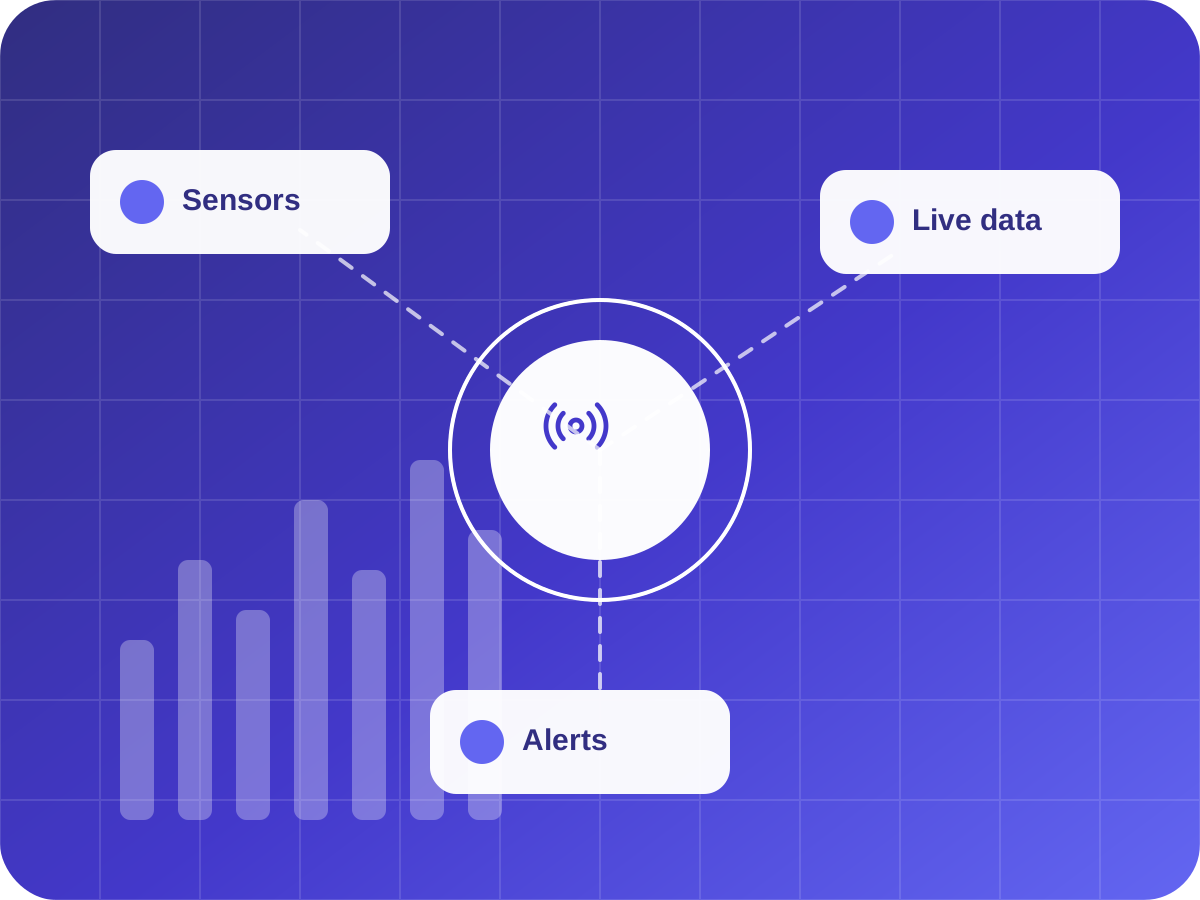
Every site keeps its existing sensors. A ruggedised edge gateway at each location collects them and buffers through network drops. It forwards the data to one platform that alerts, predicts and reports for the whole operation.
05
Five modules live, more to come
KP Iron began with the modules that retired the largest current risks. Further expansion is decided in quarterly value reviews with operations and finance.
Gas dashboards by zone, supervisor alerts within seconds, and a closed loop with the ventilation team.
Predictive interventions on the conveyor and crusher circuits, catching bearing wear and belt slip early.
06
Inside the control room
The GM, the HSE officer and the maintenance head open the same view. Four headline numbers sit on top; below them, each module has its own screen. Pick one to see what it shows.
- 17:02 Threshold crossed on L3-ZB-001; shift supervisor and ventilation team alerted by SMS
- 17:04 Alert acknowledged in the control room; auxiliary fan boosted for Zone B
- 17:41 Reading back under 0.6 %LEL; incident closed with the full timeline logged
- Critical CH₄ sensor L3-ZB-001 UG L3 Zone B · 4 min
- Warning Bearing temp · Crusher 2 Plant · 12 min
- Resolved Belt load · Conveyor North Plant · 31 min
Talk to us about one operational picture for a mine
Book a free review. We confirm the problem, the right approach and the next step.